




Why Choose Us
Wide Product Range
Our main products cover AGM VRLA batteries, GEL batteries, OPzV/OPzS batteries, font terminal batteries, 2V long-life batteries, lead carbon batteries, lithium batteries, Car batteries, etc.
Quality Guaranteed
Shimastu strictly works on quality control of all production steps, ensuring all the products a reliable performance and high quality, and the company has been certified with ISO 9001, ISO 14001, UL and CE, etc.
Wide Applications
Shimastu has been exporting to worldwide clients serving in the energy storage and power backup industry such as UPS/EPS, solar power systems, security systems, emergency lighting systems, telecom systems, data centers, etc.
High Quality Service
We specialize in research and development, manufacturing, sales, and marketing of full categories of batteries. We are committed to providing a high level of customer service, and 24/7 customer support, so all your problems can be responded to quickly.
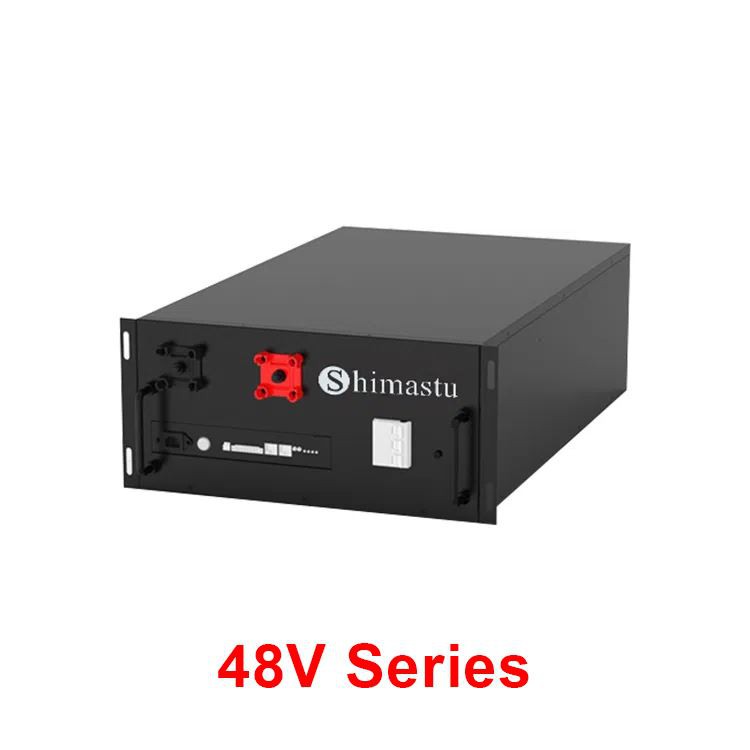
A 48V lithium battery is a type of rechargeable battery that has a voltage of 48 volts. Lithium batteries are a type of battery that uses lithium metal or lithium compounds as the anode or cathode material. They are widely used in various applications due to their high energy density, long cycle life, and low self-discharge rate. The 48V voltage rating of this battery makes it suitable for use in a wide range of applications, including electric vehicles, industrial equipment, and renewable energy systems. It can provide a balance between energy storage capacity and the ability to deliver high currents when needed.

Higher Energy Density
48V lithium-ion batteries have a higher energy density compared to other types of batteries, such as lead-acid batteries. This means they can store more energy in a smaller and lighter package, allowing for increased power and longer operating times.
Improved Efficiency
Lithium-ion batteries, including 48V systems, have higher charge and discharge efficiencies compared to traditional battery technologies. This means less energy is wasted during the charging and discharging processes, resulting in improved overall efficiency and longer battery life.
Faster Charging
48V lithium-ion batteries can be charged at a faster rate compared to other battery types. They are capable of accepting high charging currents, allowing for quicker recharge times. This is particularly advantageous in applications where rapid charging is required, such as electric vehicles or renewable energy systems.
Longer Cycle Life
Lithium-ion batteries, including 48V variants, typically have a longer cycle life compared to other battery chemistries. They can withstand a greater number of charge-discharge cycles before their capacity significantly degrades. This makes them more durable and cost-effective in the long run, as they require less frequent replacement.
Lighter Weight and Smaller Size
48V lithium-ion batteries are generally lighter and more compact than alternative battery technologies with similar power ratings. This makes them easier to integrate into various devices and systems without adding excessive weight or occupying significant space. The compact size and lightweight nature of these batteries are particularly beneficial in applications such as electric vehicles and portable electronics.
Major Applications of 48V Lithium Battery
Electric Vehicles
One of the primary applications of 48V lithium batteries is in electric vehicles (EVs). These batteries can be used as the main power source or as part of a hybrid system to provide additional power during acceleration or for regenerative braking. The 48V battery systems are often employed in mild-hybrid vehicles, which use a combination of an internal combustion engine and an electric motor for improved fuel efficiency.
Renewable Energy Storage
48V lithium-ion batteries can be utilized for energy storage in renewable energy systems, such as solar or wind power installations. These batteries can store excess energy generated during periods of high production and release it during times of low production or high demand. They help stabilize the power grid and ensure a consistent power supply.
UPS (Uninterruptible Power Supply) Systems
UPS systems are critical for providing backup power during blackouts or power outages. 48V lithium batteries can be employed in UPS systems for data centers, telecommunications equipment, or other critical infrastructure. These batteries provide reliable and high-capacity energy storage to keep essential systems running until power is restored.
Electric Bicycles
Electric bicycles, commonly known as e-bikes, are becoming increasingly popular as a sustainable mode of transportation. 48V lithium-ion batteries are used in e-bikes to provide the necessary power for the electric motor. These batteries offer a good balance between energy density, weight, and capacity, enabling longer rides and improved performance.
Marine Applications
48V lithium batteries are also suitable for various marine applications, including electric boats, yachts, and marine hybrid systems. They can provide the necessary power for propulsion, onboard electronics, and auxiliary systems. These batteries offer a higher energy density compared to traditional lead-acid batteries, resulting in improved range and performance for marine vessels.
Components of 48V Lithium Battery
Cells
Lithium batteries are made up of individual cells that are connected in series or parallel to achieve the desired voltage and capacity. Each cell contains a positive electrode (cathode), a negative electrode (anode), and an electrolyte that allows ions to move between the electrodes during charging and discharging.
Battery Management System (BMS)
The BMS is a crucial component of any lithium battery, including 48V batteries. It monitors and manages the battery's state of charge, state of health, and other key parameters to ensure safe and efficient operation. The BMS also controls charging and discharging processes, prevents overcharging or discharging, and balances the cells to ensure they operate optimally.
Charger
A charger is used to provide power to the battery, converting AC power from the mains into the DC power required by the battery cells. Chargers for 48V lithium batteries are typically designed to provide the appropriate voltage and current to charge the battery safely and efficiently.
Discharge Circuitry
Discharge circuitry is responsible for safely delivering power from the battery to the application or device it is powering. This circuitry ensures that the power is delivered at the correct voltage and current, and it may include protection features to prevent overcurrent or overvoltage conditions.
Connectors and Wiring
Connectors and wiring are used to connect the battery to the charger, discharge circuitry, and the final application or device. These components must be rated for the appropriate voltage and current to ensure safe and reliable operation.
Housing and Packaging
The battery cells, BMS, and other components are typically encased in a protective housing or packaging to protect them from physical damage and to provide a safe and secure environment for the battery's operation.
● Charge in strict accordance with standard time and procedures.
● Lithium batteries are generally in a charged half-charged state when they leave the factory, and the battery must be fully charged for the first use.
● Use the original charger, the original charger has strong supporting performance and a moderate charging rate.
● Don't often use it to charge when the under voltage protection circuit works. The concept of completely discharging the electricity and then recharging is incorrect. The greater the depth of discharge, the more times the battery is used at a loss of electricity, and the shorter the service life of the lithium battery.
Energy density by weight
At present, the energy density of lithium battery is generally 200~260wh/g, while that of lead-acid is generally 50~70wh/g. The weight energy density of a lithium battery is 3~5 times that of lead-acid, which means that the capacity of lithium battery is three to five times stronger than that of a lead-acid battery under the same weight, so lithium battery has an absolute advantage in energy storage.
Volume energy density
Since the volume energy density of a Li-ion battery is usually about 1.5 times that of a lead-acid battery, a Li-ion battery is about 30% smaller than the lead-acid battery in the same capacity.
Service life
The most popular lithium battery materials are lithium ternary and lithium iron. For example, ternary lithium batteries usually have 1000 cycles, LiFePo4 batteries have more than 2000 cycles, and lead-acid batteries usually have 300-350 cycles. Then it means that the life of lithium batteries is about 3-6 times that of lead-acid batteries.
Price Cost
Lead-acid batteries are currently cheaper than lithium batteries, which are about three times more expensive than lead-acid batteries. However, by lifetime analysis, lithium batteries have a longer life if the same cost is used.
Environmental Protection
Lead-acid batteries are very polluting, while lithium batteries are relatively greener in terms of production and recycling.
48V Lithium Battery Use Precautions
1. Lithium-ion battery stored for a long time without use, should be maintained at 50%-60% charge state, should be replenished once every 3 months, and should be charged and discharged once every six months.
2. During transportation, care should be taken to prevent moisture and humidity, and avoid extrusion and collision to avoid damage to the lithium-ion battery.
3. In low temperature, it should not be lower than 0°C. Storage at a temperature of 5°C to 10°C is optimal.
4. Prohibit the use or placement of lithium-ion batteries under high temperature (hot sunlight or very hot car), otherwise it may cause battery overheating, fire or functional failure, shortened life.
5. Prohibit storage in places with strong static electricity and strong magnetic fields, otherwise it is easy to destroy the battery safety protection device, bringing unsafe hidden danger.
6. If the lithium-ion battery emits an odor, heat, discoloration, deformation or any abnormalities occur during use, storage or charging, immediately remove the battery from the device or charger and discontinue use.
7. In the case of lithium-ion batteries, a monthly power loss of 3% to 5% is possible. Self-discharge is temperature dependent and will be higher as the temperature rises.
8. Complete discharge is the "squeezing" of a battery until it no longer produces any current. Squeeze out any current. In this case, the voltage will drop to 0 volts. If this state is maintained. A chemical reaction occurs at the electrodes of the battery, rendering it partially or completely unusable.
9. Lithium-ion batteries can be used in the temperature range of 10°C to +55°C. However, charging can only be done at a battery temperature of +5°C to +45°C.
How Long Will A Fully Charged 48v Lithium Battery Run My Home?
The range of a 48V Li-ion battery is related to the capacity of the battery itself (Ah) and the total power of the household appliances (W). Assuming you are using a 48V 200Ah solar home battery and the total power of the household appliances is 1800W, then the running time of your home is 48V*200Ah/1.8kW=5.3h.
How to Choose a 48v Lithium Battery?

Selecting the right 48V lithium batteries for your specific application is essential to ensure optimal performance and longevity. These batteries are very suitable for use in solar power generation systems, RVs and off-grid living. Here are a few key factors to consider when choosing a battery.
Capacity
Determine the amount of power you need to deliver and choose a battery with sufficient capacity to meet your requirements. Consider factors such as voltage and operating time to accurately assess your needs. When choosing a battery, take a look at the number of Watt (Wh). It accurately determines the amount of energy that can be stored in the battery.
The formula is (Ah) * (V) = (Wh). For example, if you have a 100Ah battery rated at 12V, the power is 100Ah * 12V = 1200Wh.
Form Factor
Different applications may require different form factors. Evaluate the available space and consider the weight restrictions to select a battery that fits seamlessly into your design.
Safety Features
Look for batteries that incorporate advanced safety features such as overcharge protection, thermal management, and short-circuit protection. These features are crucial in preventing accidents and ensuring the longevity of the battery. The lithium battery has a built-in BMS, which has overcharge, over-discharge, charging overcurrent, discharge overcurrent, short circuit, battery voltage self-balancing, high-temperature discharge cutoff and other protections. It has better performance, safer and longer life.
Manufacturer Reputation
Opt for batteries produced by reputable manufacturers known for their quality and reliability. Research customer reviews, certifications, and technical specifications to gain confidence in your choice.
How Many Hours Does It Take To Charge an 48V Lithium Battery to Full?
Charging time and voltage does not have much to do with.
Mainly depends on the capacity of the lithium-ion battery and the power of the charger, charging time = lithium battery capacity ÷ charging current
For example, 48V 5kWh lithium-ion battery, assuming that the maximum charge current allowed is 50Ah, then the theoretical charging time of 4 hours, that is, 200Ah ÷ 50A = 4h, but the actual charging constant current to constant voltage mode, the trickle charge at the end takes longer, so under normal circumstances are in about 5 hours. Similarly, if the allowed charging current is 20Ah, it takes 200Ah ÷ 20A = 10h, but the same trickle time, so it is about 12 hours or so.
Check the charger and power source
Ensure that your charger is working properly and that the power source is functional. Try plugging the charger into a different power socket or using a different charger if possible to rule out a charger issue.
Inspect the charging port
Check the charging port on the battery for any dirt, debris, or corrosion that may be preventing a good connection. Clean the port with a cotton swab or soft cloth, and make sure the pins are straight and not bent.
Check the battery's state of charge
If the battery is completely discharged, it may require activation before it can be charged again. This usually involves connecting the battery to a charger and allowing it to charge for a few minutes before attempting to turn on the device.
Check the battery management system (BMS)
The BMS is a safety feature in lithium-ion batteries that prevents overcharging, overdischarging, and other potentially damaging conditions. If the BMS is malfunctioning, it may prevent the battery from charging. This may require the assistance of a professional to diagnose and repair.
Replace the battery
If the battery is old or damaged, it may need to be replaced. Look for compatible replacement batteries from reliable manufacturers and follow the instructions for proper installation.
How Do I Dispose of a 48V Lithium Battery When It's No Longer Usable?
When a 48V lithium battery is no longer usable, it should be disposed of properly to prevent environmental pollution and safety hazards. Many countries and regions have specific regulations and guidelines for the recycling or disposal of lithium batteries. It is recommended to consult local authorities or recycling centers to determine the appropriate way to dispose of a 48V lithium battery in your area.
Certifications
Our batteries have been certified with ISO 9001, ISO 14001, UL and CE, etc.


Our Factory
Shimastu Electronic Technology Co.,Limited, a premier manufacturer of Sealed Lead Acid batteries&Lithium batteries,which was established in 2001 and located in Zhongshan City ,Guangdong Province,China,we specialize in research and development, manufacturing, sales and marketing of full categories of batteries,our main products cover AGM VRLA battery,GEL battery, OPzV/OPzS battery,Front Terminal battery,2V long life battery,Lead carbon battery, Lithium battery,Car battery etc.
Ultimate FAQ Guide to 48V Lithium Battery
Q: How many hours does a 48V lithium battery last?
Q: What voltage is 50% in 48V battery?
Q: Can I put 4 12 volt batteries in my 48 volt golf cart?
Q: How long will a 60ah lithium battery last in a golf cart?
Q: Is it worth converting golf cart to lithium?
Q: Do lithium batteries last 10 years?
Q: How long will a 48V 50ah battery last?
Q: What voltage is too low for lithium battery?
Q: How many lithium cells for 48V?
Q: Is 48V considered high voltage?
Q: What is a 48V Lithium Battery?
Q: How does a 48V lithium battery work?
Q: How long does a 48V lithium battery last?
Q: How do I charge a 48V lithium battery?
Q: Is it safe to use a 48V lithium battery?
Q: How do I dispose of a 48V lithium battery when it's no longer usable?
Q: How much does a 48V lithium battery cost?
Q: Are there any limitations or drawbacks to using a 48V lithium battery?
Q: Can a lithium battery last 20 years?
Q: What is the range of a 48V battery?
Hot Tags: 48v lithium battery, China 48v lithium battery manufacturers, suppliers, factory, lithium battery 206ah, 12v 6ah lithium battery, li ion cylindrical rechargeable battery, lithium ion battery for ev, battery 4200mah 3 7 v li ion, lithium ion rechargeable batteries