




Standby Battery
Your Professional Standby Battery Manufacturer in China!
Shimastu Electronic Technology Co., Limited, a premier manufacturer of Sealed Lead Acid batteries&Lithium batteries, was established in 2001 and located in Zhongshan City, Guangdong Province, China.
Why Choose Us
Wide Product Range
Our main products cover AGM VRLA batteries, GEL batteries, OPzV/OPzS batteries, font terminal batteries, 2V long-life batteries, lead carbon batteries, lithium batteries, Car batteries, etc.
Quality Guaranteed
Shimastu strictly works on quality control of all production steps, ensuring all the products a reliable performance and high quality, and the company has been certified with ISO 9001, ISO 14001, UL and CE, etc.
Wide Applications
Shimastu has been exporting to worldwide clients serving in the energy storage and power backup industry such as UPS/EPS, solar power systems, security systems, emergency lighting systems, telecom systems, data centers, etc.
High Quality Service
We specialize in research and development, manufacturing, sales, and marketing of full categories of batteries. We are committed to providing a high level of customer service, and 24/7 customer support, so all your problems can be responded to quickly.
-
![High-Rate Discharge Batteries]() High-Rate Discharge BatteriesRead More
High-Rate Discharge BatteriesRead MoreWe specialize in research and development, manufacturing, sales, and marketing of full categories of batteries. We are committed to providing a high level of customer service, and 24/7 customer
-
![AGM VRLA Batteries for General UPS Purpose]() AGM VRLA Batteries for General UPS PurposeRead More
AGM VRLA Batteries for General UPS PurposeRead MoreShimastu NP series AGM VRLA Batteries have been developed as general purpose batteries,they're valve-regulated lead acid batteries with high quality Absorbed Glass Matt(AGM) separators & high purity
-
![Front Access Backup Batteries]() Front Access Backup BatteriesRead More
Front Access Backup BatteriesRead MoreShimastu FA series Front Access Backup Batteries are specially designed for telecommunications industry with 15 years design life in float service,With terminals at the front, these batteries are
-
![Long-Life AGM VRLA Batteries]() Long-Life AGM VRLA BatteriesRead More
Long-Life AGM VRLA BatteriesRead MoreShimastu NPL series Long-Life AGM VRLA Batteries have been developed as long service life purpose batteries, the battery floating service life can target 15 years at 20oC, they're valve-regulated
-
![High-Rate Discharge Batteries]() High-Rate Discharge BatteriesRead More
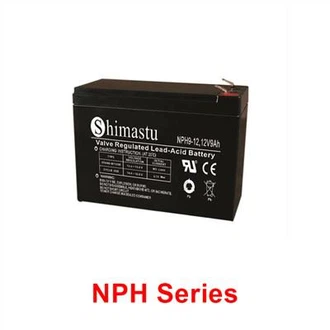
High-Rate Discharge BatteriesRead MoreShimastu NPH series High-Rate Discharge Batteries are suitable for high-power discharge by using strong grids and specially designed active material, it offers 20% more power output than the standard
-
![Classic Batteries]() Classic BatteriesRead More
Classic BatteriesRead MoreShimastu STXL series Classic batteries are designed with wide capacity range,suitable for large power system with a designed floating service life can target 15 years at 20oC. The batteries use thick



Definition of Standby Battery
‘Standby’ use - Using batteries as backup power. Batteries used in standby applications are predominately used to supply emergency power, helping prevent any damage that may be caused by sudden loss of mains power. For standby power applications, so-called stationary or standby batteries are often used. These standby batteries are rarely discharged and their charge is constantly maintained.

The standby battery produces electrical energy on demand by using the terminals or electrodes of the battery. The positive terminal is located on the top of the battery. The outer case or bottom of the battery is commonly referred to as the negative terminals. Both terminals are very common in all types of batteries.
The chemicals that surround these terminals and the battery together form the power cell. The power cell generates energy whenever the positive and negative terminals are connected to an electrical circuit. For example, the metal part in the flashlight case and the device is on. The chemicals inside the cell (alkaline or lithium) begin a reaction to produce the ions and electrons that power anything attached to the battery.
Benefits of Standby Battery You Want to Know


They are Spill-Proof
Unlike the traditional lead-acid batteries that freely flood their electrodes, AGM standby batteries have glass mats that prevent this. Additionally, it is the function of these glass mats to avoid spillage. Rather than absorbing the electrolyte, the glass mats work by holding the electrolyte in place, preventing it from spilling over, even when the battery is placed in odd positions.
They Have a High-Power Output
Because of the way that they are designed, the AGM standby batteries have minimal internal resistance. This, therefore, enables them to provide sufficient bursts of power when necessary, such as when one needs to start a battery. Due to this feature, these batteries respond better to loading than any other battery on the market.
They Have a Short Charging Time
AGM standby batteries, compared to flooded batteries, charge quickly. When compared to flooded batteries of a similar capacity, the charging rate can reach five times faster with the same power source.
They Have a Longer Lifespan
AGM standby batteries have a longer lifespan than traditional flooded batteries. Moreover, not only do they serve for a more extended period when they perform the same tasks, but they also last longer when they are not in active use. This is because self-discharging is minimized in these batteries, unlike other types of batteries, which is a huge problem. This ensures that one does not have to keep charging them after an extended period of inactivity.
They are Durable
These AGM batteries were originally designed to serve the aircraft industry. This means that they have a sturdy design, one that can handle conditions of intense vibrations, just like those in military and commercial aircraft. Because of this property, they are a favorite for high-end motorcycle riders and race car drivers. The sandwich construction method adopted in their design ensures that their internal components do not fall apart. Moreover, they are invulnerable to the subsequent wear and tear that may result from frequent and continuous vibrations. Furthermore, they can withstand extreme temperature variations.
They are Unlikely to Build up Sulfation
Sulfation is the property of lead-acid batteries, where there is a gradual accumulation of lead sulfate crystals in the cells. In most cases, it is the cause of failure in lead-acid batteries. Sulfation mostly occurs when the battery is not fully charged, and thus the crystals continuously build up on the plates. When this process goes out of hand, it prevents the efficient conversion of chemical to electrical energy. Therefore, for other types of lead-acid batteries, it is essential to charge them every six months to prevent sulfation. However, in AGM standby batteries, sulfation is significantly reduced. Therefore, they can be stored for extended periods without needing a recharge.
Aircraft Emergency Batteries
Standby batteries in aircraft keep essential instruments and devices running in the event of an engine power failure. Each aircraft has enough power in the backup batteries to facilitate a safe landing. The batteries keeping navigation, ELUs (emergency lighting units), emergency pressure or oxygen systems running at altitude, and radio equipment operational. Larger aircraft have control surfaces that run on these backups as well. Aircraft batteries are either nickel-cadmium or valve-regulated lead acid type. The battery keeps all necessary items running for between 30 minutes and 3 hours.
Burglar Alarms
Standby batteries are almost always used in burglar alarms. The backup battery prevents the burglar from disabling the alarm by turning off power to the building. Additionally these batteries power the remote cellular phone systems that thwart phone line snipping as well. The backup battery usually has a lifespan of 3-10 years depending on the make and model, and so if the battery runs flat, there is only one main source of power to the whole system which is the mains power. Should this fail as well (for example, a power cut), it usually triggers a third backup battery located in the bellboxes on the outside of the building which simply triggers the bell or siren.
Computers
Modern personal computer motherboards have a standby battery to run the real-time clock circuit and retain configuration memory while the system is turned off. This is often called the CMOS battery or BIOS battery. Backup batteries are used in uninterruptible power supplies (UPS), and provide power to the computers they supply for a variable period after a power failure, usually long enough to at least allow the computer to be shut down gracefully. These batteries are often large valve regulated lead-acid batteries in smaller or portable systems. Data center UPS backup batteries may be wet cell lead-acid or nickel cadmium batteries, with lithium ion cells available in some ratings.
Telecommunications Networks and Data Centers
A valve-regulated lead-acid battery (VRLA) is a battery type that is popular in telecommunications network environments as a reliable backup power source. VRLA batteries are used in the outside plant at locations such as Controlled Environmental Vaults (CEVs), Electronic Equipment Enclosures (EEEs), and huts, and in uncontrolled structures such as cabinets. VRLA Battery String Certification Levels Based on Requirements for Safety and Performance, is a new industry-approved set of VRLA requirements that provides a three-level compliance system.
Hospitals
Power failure in a hospital would result in life-threatening conditions for patients. Patients undergoing surgery or on life support are reliant on a consistent power supply. Standby generators or batteries supply power to critical equipment until main power can be restored.
Power Stations
Power failure in a power station that produces electricity would result in a blackout situation that would cause irreparable damage to equipment such as the turbine-generator. The safety of power station employees is a major concern during an unscheduled power outage at a power plant. A bank of large station backup batteries are used to power uninterruptible power supplies as well as directly power emergency oil pumps for up to 8 hours while normal power is being restored to the power station.

Standby Batteries
Standby basically means that a ‘standby’ battery is designed to be used on mains powered electric charge for its entire life and used only in an emergency. This is over against a ‘Cyclic’ battery which is designed for a more rigorous lifestyle of multiple uses. Standby batteries are designed to be placed on 240V Mains powered charge and only used in the case of an emergency. VRLA (Valve Regulated Lead Acid) AGM (Absorbent Glass Mat) batteries are the main technology referred to by the industry as ‘Standby’. Battery installers and specifiers will note that sometimes the AGM battery may also get labelled ‘Deep Discharge’. This is an industry labelling to differentiate the battery as utilising thicker lead plates meaning it has a longer life expectancy and will cycle better if required. Standby Batteries are popular for applications such as Electric Doors, UPS, Security Alarm Systems, Fire Suppression and Pumping Systems.
Cyclic Batteries
Cyclic batteries are batteries designed to be heavily discharged or placed on a less constant form of charge, for example, solar or wind. These batteries may come in a variety of VRLA technologies but are mainly characterise the Gel and OPzV technologies. Lithium batteries would fall under the cyclic category as well as they handle regular heavy discharges extremely efficiently. Cyclic batteries are mostly utilised in applications such as Remote solar, mobility, and wind-generated power storage.
Consider Reserve Capacity
Look for a standby battery with a high reserve capacity. This means that the battery can deliver more amperes (current) for longer periods of time, and has a low internal resistance, which means that it is not prone to overheating or overcharging.
Check the Life Span
Select a standby battery with a long life span. Check how many years you want the battery to last — this will depend on how often you use it and how much power it provides.
Check for Reliability, Safety, and Maintenance Needs
Choose one that is reliable, safe, maintenance free and environmentally friendly. If possible, try comparing standby performance rather than just starting performance because this gives a better indication of what happens when the engine is off but still running other equipment like lights. If you are buying a battery for an emergency power supply, look for one that has been tested at least once per year and labeled as “spill proof”. This will make it easier to transport and store. If you need a battery for your car, look for one that has the correct voltage and amperage capacity. This will ensure that it fits your vehicle and can handle the electrical requirements of all its components. If you are planning to get a deep cycle battery, ask how many cycles it can provide before needing replacement - this will depend on how often it is used and how much power it provides.

Maintenance Tips for Standby Battery
Visual Inspection: Regularly inspect the standby batteries for signs of damage, corrosion, or leaks. Check for loose connections or cables that may affect the battery’s performance. Address any visible issues promptly.
Temperature Control: Maintain proper temperature conditions for the standby battery storage area. High temperatures can accelerate battery degradation, while excessively low temperatures can reduce the battery’s capacity. Ensure adequate ventilation and temperature regulation to optimize battery performance.
Regular Testing: Conduct regular standby battery capacity tests to evaluate their health and performance. Load testing, in particular, can assess the battery’s ability to deliver power under simulated outage conditions. This helps identify any weak or failing batteries that may require replacement.
Cleaning and Maintenance: Keep the standby battery terminals and connections clean and free from dirt, dust, or corrosion. Regularly clean the battery cabinets and surrounding areas to prevent the buildup of debris that can impact battery performance.
Replacement Schedule: Develop a battery replacement schedule based on manufacturer recommendations, usage patterns, and test results. Batteries have a limited lifespan, and proactive replacement ensures the availability of reliable backup power.
Documentation and Monitoring: Maintain detailed records of standby battery maintenance, including inspection dates, test results, and replacements. Use battery monitoring systems to track battery health, voltage levels, and temperature. This data provides valuable insights into the condition of the batteries and helps plan for timely maintenance and replacements.
Certifications
Our batteries have been certified with ISO 9001, ISO 14001, UL and CE, etc.


Our Factory
Frequently Asked Questions (FAQ) about Standby Battery
Q: What is the typical lifespan of a standby battery?
Q: Can standby batteries be replaced?
Q: What are common factors affecting standby battery life?
Q: Does temperature affect standby battery performance?
Q: Can standby batteries be recycled?
Q: What is the role of voltage and current in standby battery charging?
Q: How often should I check the charging status of my standby battery?
Q: Can I discharge my standby battery completely?
Q: Can I store my AGM standby battery for a long period of time?
Q: Can I use my standby battery in extreme temperatures?
Q: Can I connect multiple standby batteries in parallel?
Q: Can I connect multiple standby batteries in series?
Q: Can I use my standby battery on a boat?
Q: Can I use my standby battery on an RV?
Q: Can I use my AGM standby battery as a backup power source for my home?
Q: How do I calculate the required battery capacity for my backup power system?
Q: Can I use my AGM standby battery with a UPS system?
Q: Can I use my standby battery with a solar power system?
Q: What are the 3 main chemicals inside of a standby battery?
Q: What role does the battery management system play in standby battery performance?
We're professional standby battery manufacturers and suppliers in China, specialized in providing high quality custom service. We warmly welcome you to wholesale high-grade standby battery made in China here from our factory. For price consultation, contact us.